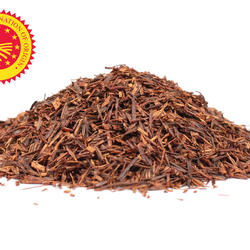
Organic Honeybush


Honeybush grows on the wild hillsides of the Cape Point. It thrives in the humid sea breeze and regular wildfires. When it sprouts, it carves its way through inhospitable terrain and when it flowers, the intoxicating fragrance is unmistakeable. The only things that can stop it from prospering are chemical fertilizers and air pollution, and that's why we love it. It brings us nature in its purest state, fragile yet untamed.
Shipping methods
| Nizozemská pošta HD - zásilkovna | Delivered by 15. 10. | 1,00 € |
|---|---|---|
 DHL DHL |
Delivered by 15. 10. | 4,90 € |


Ingredients
100 % Honeybush BIOBrew & Taste
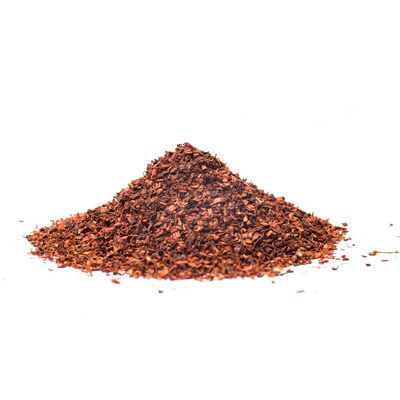
Honebyush is characterized by its beautiful mahogany color, which gives a deep orange to reddish-brown infusion. The aroma is sweet, very pleasant and the taste is indistinguishable from real honey. It is sweet, smooth and gentle. If you like your teas even when cold, try making honeybush as an iced tea.
Simply pour the warm drink over ice cubes. The result will be a delicious and naturally sweet addition to your drinking regime.
Origins

This herb has a very specific origin. By that we mean that it is not produced from the Chinese tea tree like the classic green, black or white tea, but from the Cyclopia intermedia bush. It is a plant that's around 150cm in height with long branches and needle-like leaves found only in the wilderness of South Africa, namely around the Southern and Eastern capes. It has high requirements for soil composition, humidity and light conditions, and is extremely sensitive to the presence of industrial chemicals. Therefore, the herb is 100% organic.
Honeybush was probably discovered by the African bushmen. They were enchanted by its great taste and, later, its medicinal effects. The first written mention of this exceptional shrub dates back to 1705, but its properties were not described until 1830. As it was also a valuable export item, the local people tried to establish honeybush plantations. The first one was established in 1996, but the experiment did not yield great results. In 2001, another plantation was established near Haarlem, followed by a garden in Ericaville. Honeybush, however, does not really play by the modern rules and can't stand chemical fertilizers. Despite its growing popularity in Japan, Germany and Switzerland, honeybush can so far only be harvested in the wild.
Harvesting honeybush is not easy. The pickers often have to climb the steep hillsides of the local slopes with the help of ropes. They cut the bushes with sickles about 30cm above the ground, fill the large baskets and lower them down to tractors that take them away for processing. On the farms, the whole branches and leaves are cut to a length of 6-30mm. This is followed by the natural process of fermentation. Two methods are currently used: fermentation in large piles or in preheated ovens. In the first case, the honeybush is gathered onto circular heaps 2m high and 5m in diameter. The mass, weighing 1,5-2,5 tonnes, is covered with a cloth and left for 3 days for spontaneous heating and fermentation. Fermentation in the oven guarantees a better quality product and a shorter time of 24-36 hours, but is obviously more costly. When the honeybush is finished and has gained its signature beautiful mahogany color, the sun drying comes next. It usually takes place over 1-2 days. This is followed by sifting, discarding pieces wider than a match, packing into woven bags and shipping.
Benefits of ingredients:

Herb packaging preview
We pack our herbs in a strong, zip-lock aluminum packet which allows you to easily re-seal its contents. Thanks to the hermetic seal, the herbs are protected against humidity, light and foreign odors, all of which could noticeably affect the quality of the brew and the herb itself.
Preparation
 100 °C
|
 3-5 minutes
|
 1 teaspoon for 150-200 ml
|
Instructions for preparation
Pour 150-200ml of boiled water (100°C) per 1 teaspoon of honeybush.
When brewing in a teapot add 1 extra teaspoon.
Covered, let steep for 3-5 minutes, then remove the strainer.


Are you looking for inspiration? Other customers have bought this:
Rooibos
Aladdin – Tea Blend