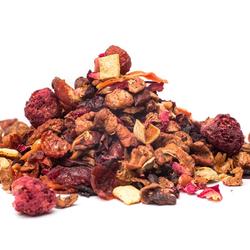
Royal Kiwi – Fruit Infusion


Not all that glitters is gold. But it can have an amazing aroma and warm you up. Our Royal Kiwi fruit tea is blended not only from bits of golden kiwi but also from mango, pineapple or apple. It tastes great and what's more, it's packed with beneficial nutrients. We've added a dash of a unique vitamin blend on top. Royal Kiwi tastes amazing both hot or iced.
Shipping methods
| Nizozemská pošta HD - zásilkovna | Delivered by 5. 10. | 1,00 € |
|---|---|---|
 DHL DHL |
Delivered by 5. 10. | 4,90 € |


Ingredients
Candied mango (mango, sugar), Carrot flakes, Apple chunks, Candied pineapple (pineapple, sugar), 10 % Candied kiwi (kiwi, sugar), Candied cherries (cherries, sugar), Natural aroma, 5 % Kiwi, Pot marigold flower, Vitamin C, Nicotinamide, Vitamin E, Vitamin B3, Vitamin B5, Vitamin B6, Vitamin B2, Vitamin B1, Folate, Biotin, Vitamin B12, Glucose syrup powderedBrew & Taste
Royal Kiwi fruit tea provides an infusion that can aptly be described as golden – it is deep yellow, with beautiful reflections. The fresh taste is dominated by the golden kiwi, of course, accompanied by the sweetness of apples and the freshness of pineapples. This tea is suitable for both hot and iced variations.
Origins
It contains vitamins A, B, C, D, E, and K. But that is not all! It's also rich in iron, potassium, magnesium, phosphorus, and copper. Yes, we're talking about the golden kiwi, the fruit of a perennial, climbing plant that originated in China and is now grown in New Zealand, Italy, Chile, and even France and Japan.
Actinidia chinensis can reach several meters in length, has heart-shaped leaves and needs support to grow well. In natural conditions, it climbs on trees and in plantations on dedicated wire systems. Automatic irrigation systems are often installed on farms to meet the hydration demand of this plant.
The high popularity of the kiwifruit has led to the development of several varieties of ''golden'' fruit in the last century. The first such fruit was harvested by botanists in 2001, a cultivar developed in Wuhan, China. Similar steps have also been taken by Italian and New Zealand scientists.
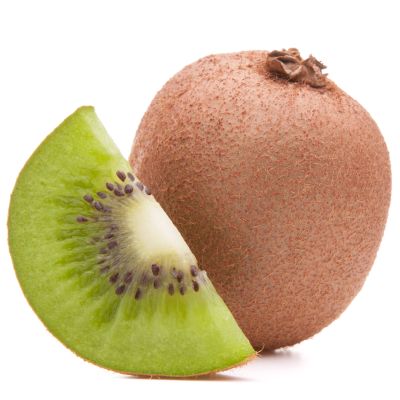
The so-called golden or yellow kiwifruit can be found on the market under the brand names Soreli, Enza Gold or Zespri Sun Gold. Their main advantage is thinner skin with almost no hairs and a sweeter, milder flavor than we are used to with regular kiwifruit. It's similarly oval to ovoid in shape, with brown or golden yellow skin and deep yellow flesh.
It is the flesh that is interesting about the golden kiwi, as most people find its typical taste very attractive. Describing what it tastes like is not quite so easy, some people think it smells of pineapple and banana, others think it resembles strawberries and gooseberries. Either way, it's extra popular. Another reason for the popularity of the golden kiwi is its unusually high content of vitamins C and E, vital antioxidants, as well as potassium, magnesium and calcium. It's usually eaten raw, but kiwi is also used in the preparation of various desserts, jams or drinks such as juices, smoothies or fruit cocktails.
Benefits of ingredients:



Tea packaging preview
We pack our teas in a strong, zip-lock aluminum packet which allows you to easily re-seal its contents. This container protects the quality of the tea against humidity, light or foreign odors, all of which could noticeably affect the quality of the brew.
Preparation
 100 °C
|
 8-10 minutes
|
 1 teaspoon for 150-200 ml
|
Instructions for preparation
Pour 150-200ml of boiled water (100°C) per 1 teaspoon of tea.
When brewing in a teapot add 1 extra teaspoon.
Covered, let steep for 8-10 minutes, then remove the strainer.


| Energy value: | 13 kJ / 3 kcal |
| Fats: | 0.1 g |
| of which saturated: | 0.1 g |
| Carbohydrates: | 0.7 g |
| of which sugars: | 0.3 g |
| Proteins: | 0.1 g |
| Salt: | 0.01 g |
Are you looking for inspiration? Other customers have bought this:
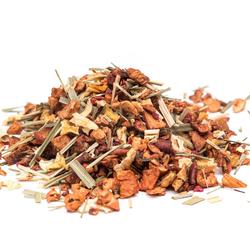
Motivational blend – Fruit Infusion
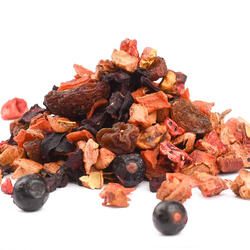
Child's Dream – Fruit Infusion